
Silver Caps on Baby Teeth: What They Are, Why Dentists Use Them, and What You Can Ask for Instead

You’re sitting with your toddler in the dental chair, and the dentist delivers the news: your child needs a crown. Then they mention silver caps. Your first reaction is probably some version of: Wait — does my kid have to have metal in their mouth?
That’s exactly the right question. And the short answer is: no, metal isn’t your only option. But before we get to what the alternatives are, it’s worth understanding what silver caps actually are, why most dentists still use them, and what to say when you want something different.
What Are Silver Caps on Baby Teeth?
Silver caps — more formally called stainless steel crowns — are prefabricated metal crowns placed over a baby tooth when decay has become too extensive for a filling. When a cavity destroys a large portion of the tooth, there’s simply not enough structure left to anchor a filling. A crown covers and protects what remains, keeping the tooth functional until it naturally falls out on its own timeline.
Stainless steel crowns have been used in pediatric dentistry for decades, and for practical reasons: they’re durable, cost-effective, and — this matters with young children — they don’t require the tooth to be completely dry during placement. If you’ve ever tried keeping a wiggly three-year-old still with their mouth open, you understand why that’s a meaningful advantage.
Are Silver Caps the Same as Mercury Fillings?
This is one of the first questions parents ask — and it’s important to be clear about it.
No. Stainless steel crowns do not contain mercury.
The metal fillings that contain mercury are called amalgam fillings — sometimes called silver fillings — and they’re an entirely different material. Amalgam is approximately 50% mercury, which is a legitimate concern for children whose brains and nervous systems are still developing. That mercury is released continuously during chewing and temperature changes, and research has raised enough concern that many countries have banned amalgam in children entirely. The U.S. has recommended against its use in children under six and in pregnant women.
Stainless steel crowns are different. They’re made from stainless steel — the same type of metal used in cookware and surgical instruments. It’s considered an inert, non-reactive metal, and it does not carry the same mercury-related concerns as amalgam.
“I want to make sure you’re understanding that amalgam fillings and stainless steel crowns are not the same thing. Stainless steel crowns do not have mercury in them.” — Dr. Michelle Jorgensen, Founder of Total Care Kids
That said, stainless steel does contain nickel, which some children react to. And for families who simply prefer that nothing metal goes in their child’s mouth — that’s a completely valid preference, and one we take seriously.
Why Do Most Pediatric Dentists Still Use Stainless Steel Crowns?
If metal-free alternatives exist, why does stainless steel remain the default at most practices? Primarily for three reasons:
- Cost. Stainless steel crowns are significantly less expensive than zirconia (porcelain) crowns, both for the practice and for families.
- Ease of placement. They can be placed more quickly, even in children who have difficulty sitting still — and they don’t require the extreme precision that zirconia crowns do.
- Insurance coverage. For families using dental insurance, stainless steel is usually the covered option. Zirconia crowns are typically out of pocket.
These are understandable reasons. They’re not a sign that your dentist doesn’t care — they’re reflections of how pediatric dentistry has been structured for decades. But knowing alternatives exist is the first step to asking for them.
What’s the Alternative to Silver Caps on Baby Teeth?
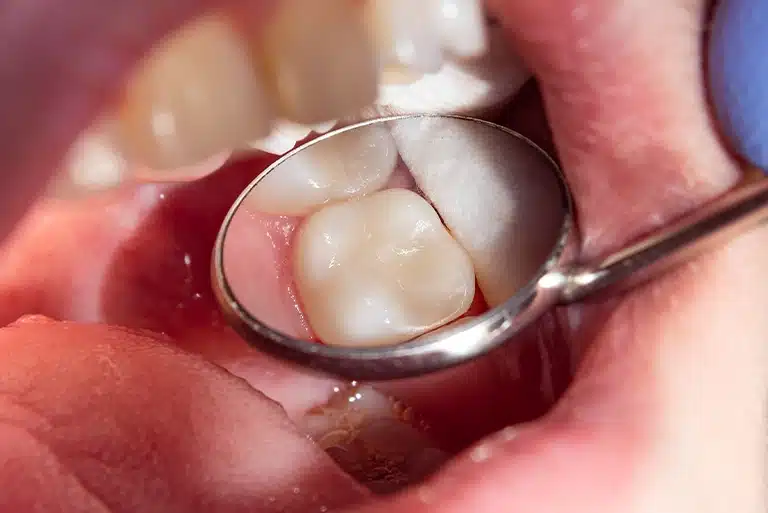
For parents who want to avoid metal entirely, the primary alternative for baby tooth crowns is zirconia.
Zirconia crowns are made from a hard, all-porcelain material. They’re white. They look like actual teeth. And they contain no metal of any kind.
A few things parents should know about zirconia crowns for kids:
- They’re strong. Zirconia is one of the hardest dental materials available — durable enough to hold up to normal childhood eating and activity.
- They require more precision to place. Because they’re custom-fit rather than prefabricated, they take more time and skill to place correctly. Not all pediatric dentists offer them routinely.
- They cost more. Zirconia crowns are more expensive than stainless steel, and most dental insurance plans don’t cover them. If cost is a concern, it’s worth asking about your specific situation.
- They work in most situations. Occasionally, very small or tight mouths create placement challenges — but the vast majority of children are good candidates.
At Total Care Kids, zirconia crowns are our standard approach. When a child needs a crown, our first goal is always a tooth-colored, metal-free restoration — and we’re able to achieve that in the great majority of cases we see.
Watch: Dr. Michelle Explains Your Options (Fillings and Crowns)
Dr. Michelle Jorgensen — founder of Total Care Kids and author of Healthy Mouth, Healthy You — walks through the difference between mercury fillings, stainless steel crowns, and the metal-free alternatives available today.
Dr. Michelle explains the difference between amalgam fillings, stainless steel crowns, and the biocompatible alternatives your child’s dentist can use instead.
One Honest Note: Space Maintainers
There’s one more place metal may come up in your child’s dental care, and we’d rather tell you about it upfront than have you be surprised.
If a baby tooth is lost early — because of decay, injury, or other reasons — a space maintainer is sometimes needed to hold open the gap until the permanent tooth comes in. Space maintainers are most commonly made from stainless steel.
This is not the same thing as a filling or a crown. And while the dental field continues to explore alternatives, reliable metal-free space maintainers remain limited. If your child ever needs one, we’ll explain everything fully and answer all your questions. We believe you should understand every decision in your child’s care.
What to Say at Your Child’s Next Dental Appointment
You don’t have to be a patient at Total Care Kids to ask for metal-free restorations — though we’d love to have you. This is something you can advocate for at any pediatric dental practice.
Dr. Michelle’s recommendation is simple: “Just say, ‘I don’t want any metal. What are my alternatives?’” A dentist who offers biocompatible alternatives should be able to walk you through composite resin for fillings and zirconia for crowns. If they can’t — or if they discourage you from asking — that’s information worth having.
At Total Care Kids, we have this conversation with parents every single day. It’s not a difficult request — it’s a reasonable one. And it’s exactly the kind of care we’ve built this practice to provide.
If you’d like to learn more about our approach to restorations, visit our metal-free fillings and crowns page for a full overview of the materials we use and why.
Frequently Asked Questions
Why do dentists put silver caps on baby teeth?
When a cavity destroys too much of a baby tooth for a filling to hold, a crown is needed to protect the remaining tooth structure. Stainless steel crowns — often called silver caps — have been the standard choice in pediatric dentistry because they’re durable, affordable, and relatively easy to place, even in young children. However, tooth-colored alternatives like zirconia crowns are now available at practices that specialize in biocompatible care.
Are stainless steel crowns safe for kids?
Stainless steel crowns do not contain mercury — that’s a common misconception. They’re made from stainless steel, which is considered a non-reactive metal and is used widely in cookware and surgical instruments. They do contain nickel, however, which can be a sensitivity concern for some children. Families who prefer no metal in their child’s mouth have the option to request zirconia (porcelain) crowns instead.
What are the alternatives to silver caps on toddler teeth?
The primary alternative is a zirconia crown — an all-porcelain, tooth-colored crown that looks like a natural tooth and contains no metal. Zirconia crowns are placed routinely at practices that offer holistic or biological pediatric dentistry. They tend to cost more than stainless steel and are usually not covered by dental insurance, but they’re a well-established option for families who want metal-free care.
Do silver caps and mercury fillings contain the same materials?
No — these are different materials with different compositions. Mercury fillings (amalgam) are approximately 50% mercury combined with other metals. Stainless steel crowns contain no mercury. They’re made from stainless steel, which is considered inert and non-reactive. The concerns about each material are distinct.
Can a toddler get a zirconia crown?
Yes. Zirconia crowns can be placed on baby teeth in toddlers and young children when a crown is clinically appropriate. Placement requires a degree of cooperation from the child, and in some cases very small or tight tooth spacing can present challenges — but most young children are good candidates. Your dentist will be able to advise based on your child’s specific situation.
Does Total Care Kids use stainless steel crowns?
Our goal at Total Care Kids is always a metal-free restoration. When a crown is needed, we use zirconia crowns as our standard approach. The one exception is space maintainers — when a baby tooth is lost early and space needs to be held for the permanent tooth, stainless steel is still the most reliable option currently available. We’ll always explain the situation fully before any treatment begins.